
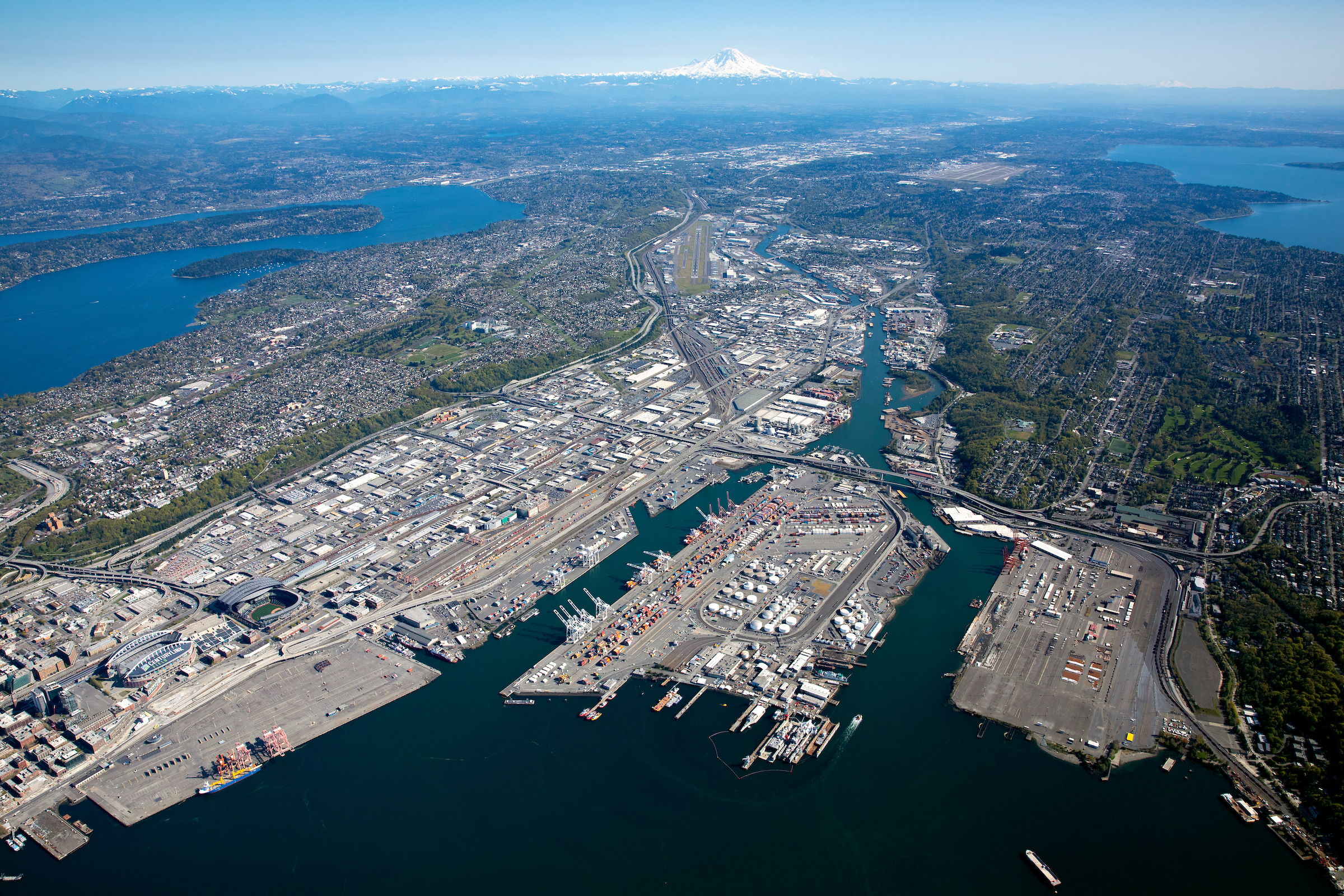
The NWPCAS is a unique collaboration between The Northwest Seaport Alliance and the ports of Seattle, Tacoma, and Vancouver, British Columbia, to voluntarily reduce seaport-related emissions that contribute to air and climate pollution in the shared Puget Sound-Georgia Basin Airshed. In 2020, the Northwest Ports renewed the strategy and established an ambitious vision:
To phase out emissions from seaport-related activities by 2050, supporting cleaner air for our local communities and fulfilling our shared responsibility to help limit global temperature rise to 1.5°C.
The NWPCAS has proven to be a very effective mechanism for collaborating on clean air and climate solutions across the four ports in the airshed, as those ports continue to pursue their respective commercial, job creation, and economic development goals.
What is the Northwest Ports Clean Air Strategy?
First adopted in 2008, the Strategy was the first international strategy of its kind in the Port community. The original Strategy sought to encourage environmental action above competition and created a means for the four Northwest Ports to work collectively and voluntarily to reduce air pollution. The updated 2020 strategy advances the greenhouse gas emission reduction targets adopted by the Port of Seattle, Port of Tacoma, and NWSA via resolutions in 2017; aligns with the most recent climate science; recognizes the urgency to address environmental health disparities; and provides an ambitious but flexible timeframe for action.
The NWPCAS has been developed in partnership with U.S. and Canadian government agencies including the U.S. Environmental Protection Agency, the Washington State Department of Ecology, Puget Sound Clean Air Agency, Metro Vancouver, Province of British Columbia, Transport Canada, and Environment Canada, with input from non-governmental organizations, near-port community groups, industry, and local governments.
To advance the 2050 vision, the Strategy sets joint objectives that the Northwest Ports will work toward in each sector:
Implement programs that increase efficiency, phase out old, high-emitting equipment, and increase use of lower-emission fuels;
Facilitate collaboration among government, utilities, fuel providers, and industry to ensure the infrastructure needed to enable zero-emission technologies in the place at the right time, addressing key constraints as soon as possible before 2030; and
Facilitate collaboration toward commercialization and drive adoption of zero-emissions technology before 2050.
Scope of the Northwest Ports Clean Air Strategy
The NWPCAS seeks to reduce emissions from key operational sectors including:
- Ocean-going vessels
- Drayage trucks
- Cargo-handling equipment
- Rail
- Harbor vessels
- Port admin and facilities
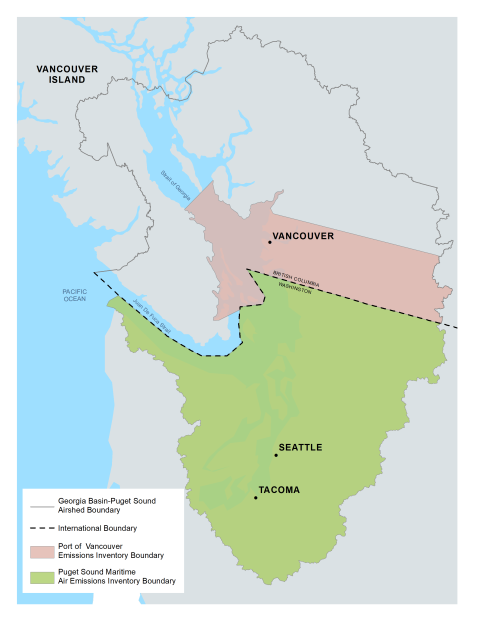
Past versions of the NWPCAS have focused on diesel particulate matter (DPM), the key driver of air pollution related impacts in the Puget Sound region, and greenhouse gasses (GHGs). In the new 2020 NWPCAS, the ports place increased focus on other air pollutants and emissions that affect climate such as nitrogen oxides, volatile organic compounds, and black carbon, while maintaining focus on DPM and GHGs. Operations within the “airshed” boundary are considered, with the U.S. ports focused on activities south of the border. A map of the airshed boundary is on the right; the green shaded area is the U.S.-ports area of influence.
In addition to the 2050 vision, the 2020 NWPCAS set an interim emission intensity target to reduce Scope 1, 2, and 3 GHG emissions by 50% by 2030 relative to 2005 levels.
Progress
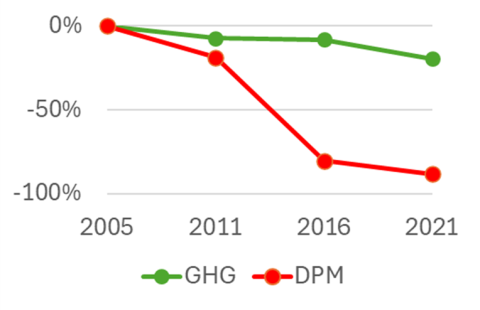 Northwest Seaport Alliance Greenhouse Gas (GHG) and Diesel Particulate Matter (DPM) emissions 2005 - 2021
Since implementation of the NWPCAS began in 2008, substantial progress has been made toward the strategy goals. Progress has been documented in the annual Implementation Reports.
The U.S. ports estimate their emissions every five years in an effort called the Puget Sound Maritime Air Emissions Inventory. The results of the most recent 2021 PSEI indicate that the Northwest Seaport Alliance experienced a 89% reduction in DPM emissions and a 20% reduction in GHG emissions compared to 2005 levels. GHG emissions continue to fluctuate with levels of activity (e.g., vessel traffic and cargo volumes), and oceangoing vessels continue to be the largest contributor to maritime-related emissions in the airshed.
NWSA emission reduction initiatives and drivers (2021 PSEI):
- Implemented a requirement for drayage trucks calling at the NWSA’s international container terminals to meet model year 2007 emission standards, greatly reducing air pollutant emissions from trucks
- Reduced at berth vessel emissions through use of shore power at the TOTE terminal in Tacoma; about 100 calls connect annually
- Partnered with Rail Management Services to deploy 6 battery electric yard tractors at the South Intermodal Yard in Tacoma Increased the number of cargo handling equipment meeting Tier 4 emission standards
- The container shipping industry continues to transition towards larger vessels, resulting in fewer vessel calls in the NWSA cargo gateway and therefore reduced emissions from transiting ships
Implementation at The Northwest Seaport Alliance
The Northwest Ports have developed port-specific implementation plans to implement the NWPCAS vision and objectives in their own lines of business and continue to report annually on the progress.
The 2026-2030 NWSA Clean Air Implementation Plan (CAIP) is the NWSA’s five-year implementation plan for the Northwest Ports Clean Air Strategy. which was adopted by the NWSA Managing Members in 2026. The overarching goals of this implementation plan are as follows:
- Do our part to improve local air quality, especially in places where environmental health disparities exist, according to the Washington Department of Public Health;
- Do our part to meet the global climate challenge – to reduce greenhouse gas emissions in alignment with limiting global temperature rise to 1.5°C to help avoid the worst impacts of climate change; and
- Sustain and strengthen our competitiveness in the cargo shipping industry to advance our core mission: facilitating international and domestic trade that supports more than 52,000 jobs and $14 billion in business activity throughout Washington state.
The CAIP includes detailed action plans to work towards the following list of priorities (among others).
- Continue working towards the NWPCAS goal of installing shore power infrastructure at our international container terminals by 2030 and maximizing connection rates.
- Catalyze the uptake of Zero/Net Zero (ZNZ) maritime fuels through implementation of green shipping corridor projects and our ZNZ Fuels program.
- Plan for and install infrastructure to support deployment of zero emission cargo-handling equipment (CHE) and support deployment of zero emission CHE.
- Support the deployment of zero emission drayage trucks and installation of associated charging and fueling infrastructure.
- Continue progress on transitioning the NWSA’s own fleets to zero emissions.
- Drive increased use of renewable diesel in trucks, CHE, and other port related applications.
- Expand mechanisms to engage and partner with communities on implementation.